

Two Birds with One Clone?
Or, Acceptance

An Evening Like Any Other
Bird was in her usual spot between me and Joe on the couch. Actually, it’s her dedicated spot, complete with a cat-sized heating pad (always turned on, of course) and her own Barefoot Dreams blanket, folded and rolled to provide the perfect amount of support and cushiness. A small set of steps leads up to her spot, so her 16-year-old joints don’t have to tax themselves as she comes and goes from said spot. If Joe or I or an uninformed guest deign to sit on her spot, she will perch atop her steps and stare at the perpetrator until they get the message and get out of the way.
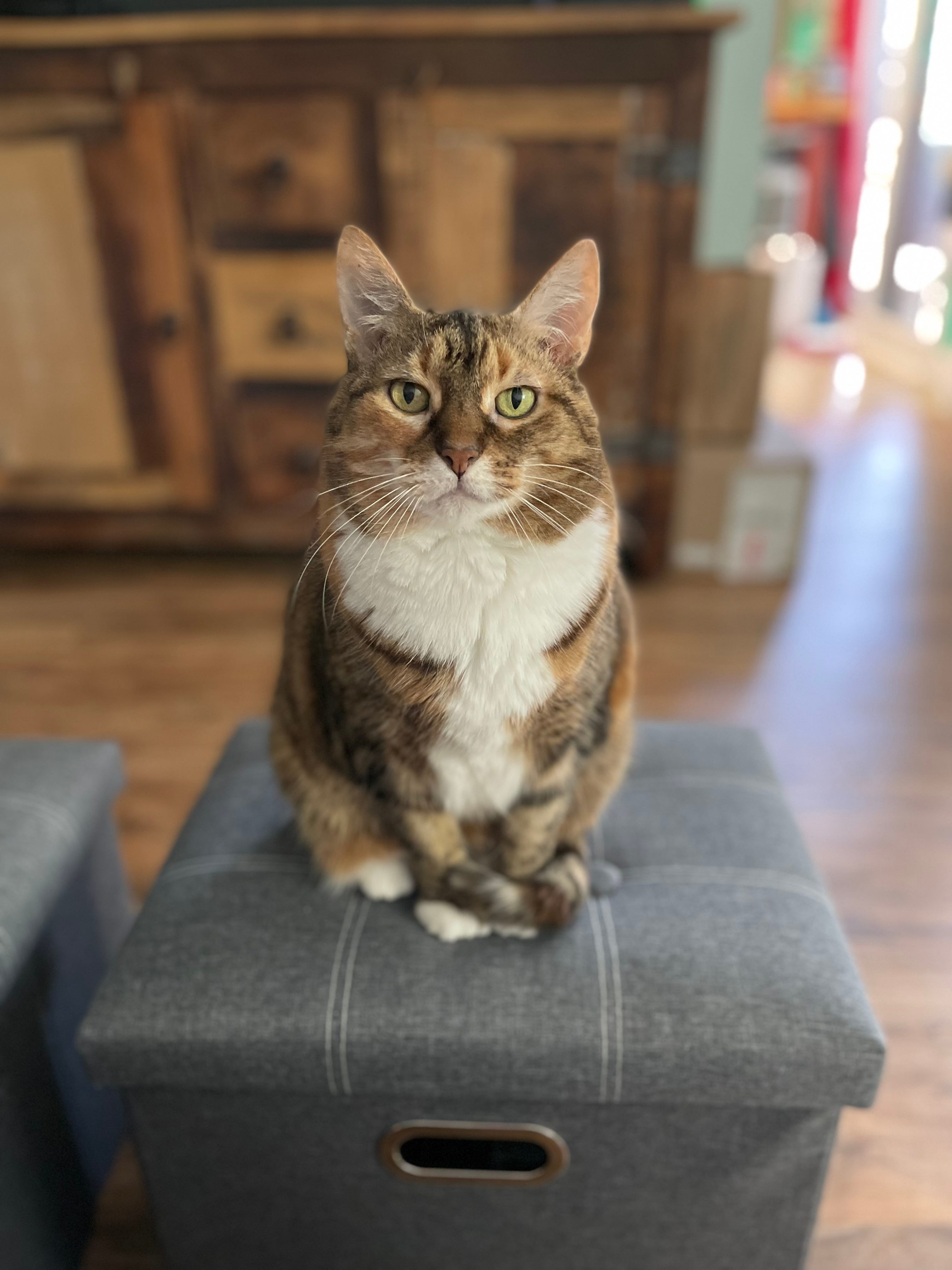
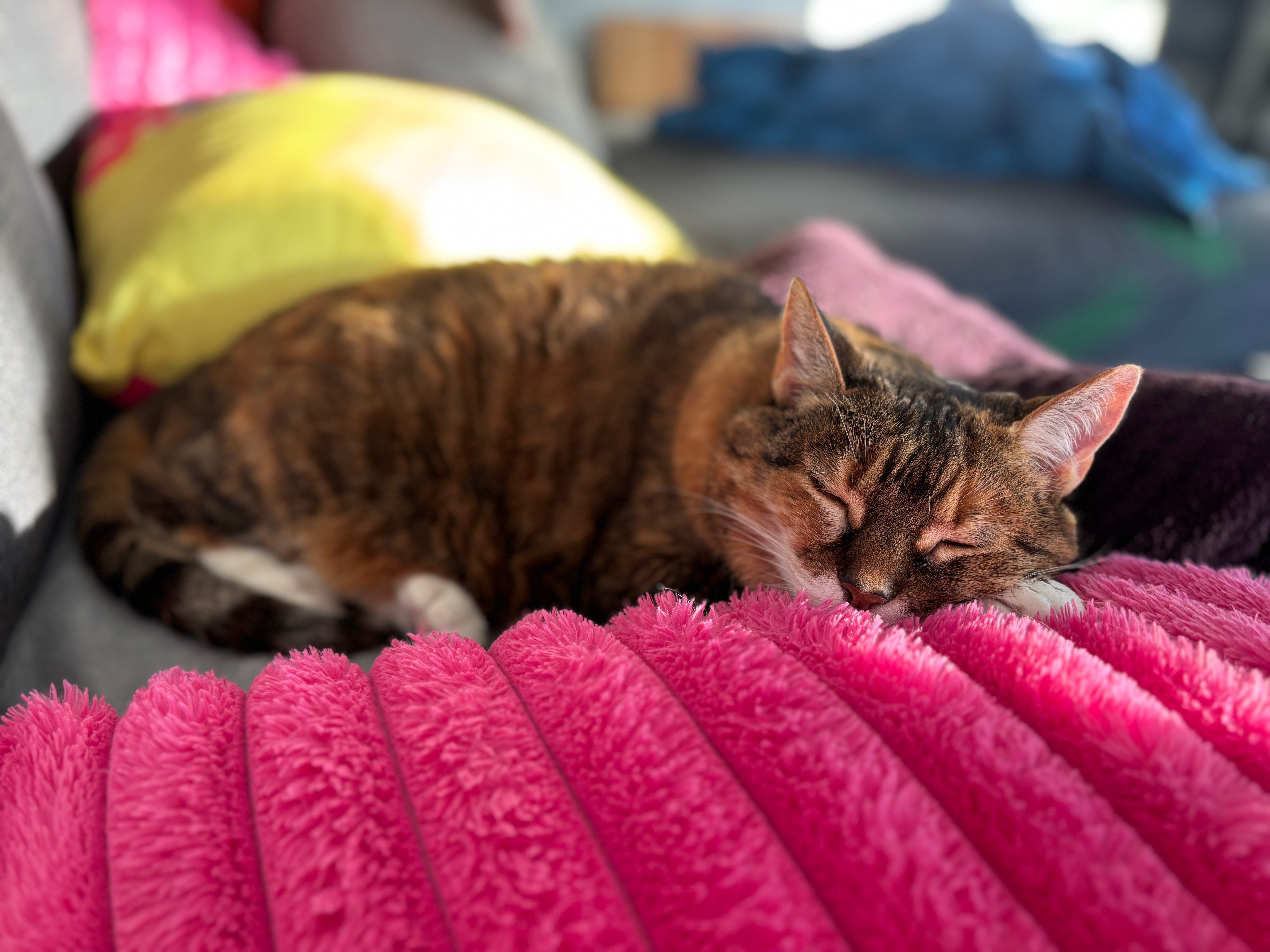
But that night, we were respecting her domain. She was curled into her usual upside-down seashell-like shape, her belly displayed so we could stroke her ultrasoft fur. She was purring madly — she has both in-breath and out-breath purrs — and in absolute bliss. And so was I, just bearing witness to her magnificence.
“She’s just … perfect,” I said to Joe. He looked over at me, then followed my gaze down to Bird, and smiled.
“She really is,” he agreed.

It had been six months or so since we lost Bird’s sister, Dodo. Before you ask, their names — which are actually nicknames — developed independently. A happy coincidence. We adopted them from the local shelter at eight weeks. They were littermates, rescued from Baltimore City at just five weeks old. Dodo got our attention by yelling at us from the cage she and her siblings were in. We noticed she was polydactyl — she had an extra toe on each paw. We wondered if anyone else in the litter was polydactyl, and that’s when we found Bird. Quietly positioned in the back of the cage, a patient loaf letting her sister do all the work.
Those personalities continued through their nearly 15 years together in our home. Dodo needed all the attention; she had autoimmune issues most of her life and became a frequent flyer at the vet. She was always, always hungry. We had to separate their food stations because Dodo would guzzle her food down and start on Bird’s before Bird had even made it to the dish. Bird was always in the background; solid, stoic, and strong. Every now and then she’d assert herself with a swat to Dodo’s head or by slowly lying down on top of Dodo in a prime napping spot or aggressively licking Dodo’s face into oblivion to get her to move out of the way.

“No, I mean really perfect,” I continued. I felt myself getting worked up. My heart swelling. My devotional wave cresting. “She’s absolutely wonderful. No other cat looks like her. She’s so sweet. She’s got so much personality. She’s the most perfect cat ever. There will never be another cat so perfect.”
When Dodo passed at 14 (though we tell everyone she made it to 15, giving her extra credit for scrapping along her whole life with all those health issues) I experienced a new depth of grief. I sobbed as I put away her food bowl after what we knew would be her last meal, while she was still on the couch watching me and probably wondering what the hell was so wrong. I sobbed that night, after the deed was done, when she wasn’t in her usual sleeping spot next to my head. I sobbed two weeks later — on what had been a relatively “good” day — when the veterinarian called to say that the plaster cast of her tiny five-toed paw print was ready for pickup.
But the silver lining to that experience was that Bird positively blossomed. A whole new side of her personality came out as we were finally able to shower her with the attention she deserved. I thought about the guilt parents feel when one child is needier than another and naturally gets more attention because of it. Since Dodo died, we’d done everything we could to make up for lost time, and Bird eventually trusted it and opened up more to us. We felt so grateful that she’d stuck around long enough to let us bask in her brilliance and feel the warmth from her whole heart.
Joe was trying to hang with my gushing, but I could see his attention waning. He wanted to get back to our show.
“Maybe we should clone her!” I announced, doing that thing I do where I take a passing observation and try to Make It Something. “Isn’t that a thing now?”
And off I went. Joe went back to the show. Bird kept sleeping.
Everyone’s Doing It!
I started googling “pet cloning” on my phone, then, ever the elder Millennial, determined that this was a job for a larger device and grabbed my laptop. As it turns out, anyone with $50,000 and a DNA sample can clone their cat or dog (cloning a horse will cost you $100k). Lots of people are doing it. Tom Brady cloned his pitbull mix via Colossal Biosciences, the cloning company in which he’s a partner and that is currently trying to de-extinct the wooly mammoth (because apparently, Jurassic Park taught us nothing). Barbara Streisand commissioned two clones of her pup.
And then I stumbled upon something I didn’t even know existed: the animal influencers. The social media personalities whose income depends upon accounts that follow their furry companions. Some of them are upfront about their decision to clone, and have even built their influencership around it. Clone Kitty, for example, has 88k+ followers on Instagram, 140k+ on TikTok, and has been featured on Good Morning America, Today, and in The Washington Post. Her website links to dozens of other cloned animals’ social media accounts.
So yes, I think it’s “a thing” to clone your pet now. But how? The quiet click of the keyboard proceeds.
How to Clone a Cat
Cloning starts with a tissue sample. A veterinarian takes a full thickness skin biopsy from the cat while it’s under sedation or light anesthesia. Viagen—a cloning company that Colossal Biosciences recently acquired and is the only commercial pet cloning company in the U.S.—promises this is a “quick, minimally invasive procedure” that heals within a few days. According to an LA Times article, it can be “uncomfortable and take a few weeks to heal.”
Noted.
The cloning company then takes an unfertilized egg from a donor female, takes out its nucleus and replaces it with the nucleus from one of your cat’s cells. Add in a little Frankenstein-y zap to encourage cell division, and once the embryo starts developing it’s implanted into a surrogate that carries it to term. Birth is either natural or via c-section, depending on the how the pregnancy and labor proceed.
Once the cloned cat has been weaned, it’s delivered to you; a genetic duplicate of your beloved pet.
Hang On a Minute…
And here is where I can’t help but pause, can’t ignore the guilt-ridden tugging in my gut. It’s the mention of the “donor egg” and “surrogate.” Because those are living, breathing cats we’re talking about. And cats certainly can’t consent to a life in a laboratory. And even if it’s the cushiest, swankiest, most loving of laboratories, what makes my cat’s life more valuable than theirs?
The more I research, the ickier I feel. The Viagen website reads like a Black Mirror episode, promising “this is nature, faithfully preserved through world-leading science.“ Slow-motion videos, gentle female voiceovers, and montages of cute cats and kittens tug at my heart and remind me about how slow blinks and biscuit-making mean they love you and how having a cat increases your mental and physical health. Viagen repeatedly states that often (but not always, as I’m sure their lawyers advised them to say), the cloned cat will have your original pet’s temperament, personality, and intelligence. ”This is not just a likeness in spirit, but a true biological match with the same DNA.”
But the thing is, that’s not really true. Quoted in an article the LA Times article I mentioned, veterinarian Dr. Ezra Ameis says, “The offspring is a genetic twin, not an identical copy. Cloning recreates the genotype, the pet’s DNA blueprint, but not the phenotype or how that DNA is expressed in real life. Environment, maternal influence and random developmental factors shape personality and behavior. Think of it like identical twins raised in different homes.”
Even the duplication of physical markings is a crap shoot. Just as human development comes with different genetic possibilities for eye color, nose shape, and other traits — a roll of the dice when the parents’ DNA combines — the genes may line up differently in a clone than they did in the original cat.
So … what’s the point, then? The point of cloning Bird would be to get Bird back, not some foreign doppleganger. I want my Bird — the one who starts off a nap curled up tight like a warm cinnamon roll and, as she settles into the zen, ends up half-flipped and stretched out like unbaked croissant dough that a toddler just “helped” with.
If I cloned Bird, I wouldn’t be getting her back. I’d be getting a very expensive, argumentably uneethically sourced … cat. Assuming the average shelter adoption costs $50, I could rescue 1,000 other cats for the cost of producing her clone. Cloning her would, I believe, be a pricey attempt to delay or avoid the grief of losing her; to never have to put her food bowl away one last time, to always be able to look over and see her where I know she’ll be.
I decide, finally, that my grief can’t be avoided. It’s part of the package; life’s bittersweet BOGO.
Today
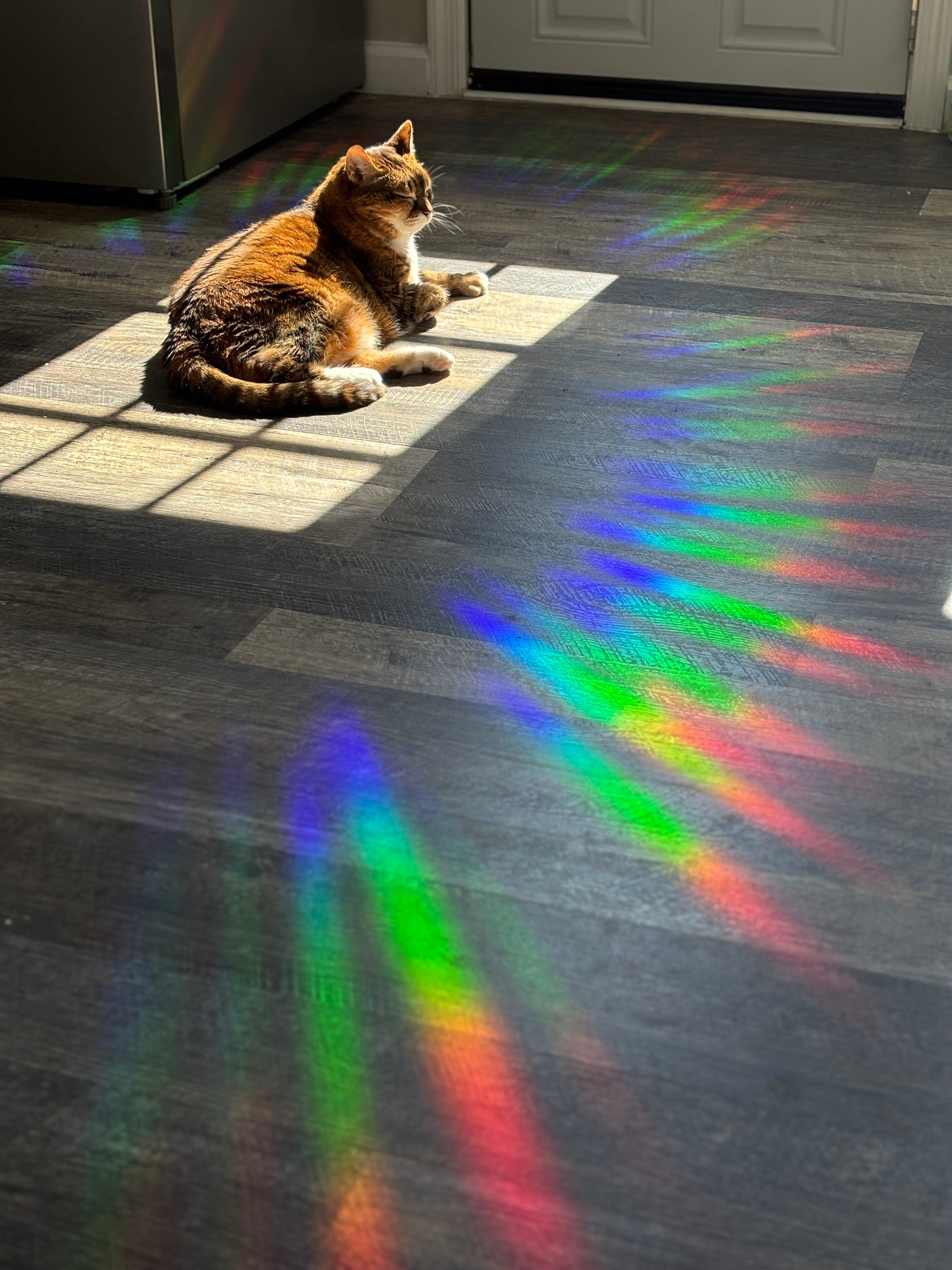
I’ve had it with the weeks of on-and-off rabbit-holing on this topic. I close my laptop, turn to Bird, curled up on a blanket here on my desk, and say, “Good Lord. I love you, but I can’t get you back!” Her eyes pop open at the sudden sound of my voice, then quickly revert back to slits when she realizes it’s just Mama being her weird self as usual. She blurs into blotches of orange, black, white, and brown as a few tears come.
Here’s the uncomfortable, harsh truth: Bird will die one day, and that day will be relatively soon. That blissfully curious moment on the couch with her was months ago. Since then, she’s turned 17 and been diagnosed with Stage 3 kidney disease. We switched her to a kidney-friendly diet. Still, we can tell she’s losing muscle mass; she’s bonier than she used to be.
I’m experiencing a little bit of anticipatory grief lately, as pet parents are wont to do. She’s having a downish day. She wants to be close, hence my desk space being reduced by a third, but at least I can reach over and pet her soft, soft fur. Whenever I do, her whole body inflates as she gives me a quick “Brrmmp!” chirp and purrs a bit. She’s curled up, ears pricked as I reopen my laptop and she listens to the keys clacking away.
She extends one of her paws and rests it against my arm as I type, and I’m reminded that her plaster paw print will have six toes because she always had to one-up her sister. I know our days together are numbered, and that’s okay — that’s what makes them matter. Because she is my one, precious Bird.

✨ If you’re here, reading this footnote, I’m ever so grateful. ✨
A free subscription means the world. Truly.
A paid subscription? That’s next-level kindness. I’ll definitely send you something sparkly in the mail if you want. (Seriously—glitter is at the ready.)
Not a fan of subscriptions? That’s okay too! My writing assistant, Bird, accepts tips in the form of snacks and chin scritchies.

Or help for free by tapping the magic buttons! A like, comment, or restack helps my writing see the Substack daylight and helps me find more kindred spirits.
Love this touching and thought-provoking piece. Coincidentally, I recently interviewed a well-known bioethicist for Minding Mittens/Fireside C(h)ats and we talked about companion animal cloning. Several of the themes you raise came up too: the exploitation of the donor animals, the fact that there are so many animals waiting in shelters, the very real possibility that the animal won’t look like the one that passed. But most importantly, as you note, it won’t be the same animal. And there are no shortcuts in grief. It hurts but it is part of the package of sharing our lives with companions animals. It bothers me that there is now a whole industry out there preying on people when they are most vulnerable and promoting the idea that animals are commodities, to be replaced with one that’s ’just the same.’ So many interesting and ethically important issues to consider. And so much heart in your piece. Margo also had kidney disease and my little Maya passed from it, so I understand 🫂. Margo also blossomed when she became an only cat. All the best to you and your little sweetheart.